BCH394P BCH364C 2026
BCH394P/BCH364C Systems Biology & Bioinformatics
Course unique #: 57450 / 57345
Lectures: Tues/Thurs 9:30 – 11:00 AM WEL 2.246
Instructor: Edward Marcotte, marcotte @ utexas.edu
- Office hours: Mon 4 – 5 PM on the class Zoom channel (available on Canvas)
TA: Zoya Ansari, zansari @ utexas.edu
- TA Office hours: Tues 11:30-12:30 / Wed 1-2 in MBB 3.204 / 3.304 (respectively) or by appointment on Zoom
Class Canvas site: https://utexas.instructure.com/courses/1435760
Lectures & Handouts
Apr 16 - 23, 2026 - Final Project Presentations
- Welcome to the end of the course! You made it! The last 3 days will be presentations of your class projects.
- Please don't forget to do the Course - Instructor Survey on Canvas!
Here's a sampling of some of the completed course projects (posted with permission):
- Long-read RNA-seq analysis of STAT3-associated transcription in pancreatic cancer cell lines, by Andrea Romero
- Tracking Biomedical Research Trends and Predicting Future Directions in PubMed through Semantic Embedding Analysis, by Dhruba Dey, Sangmin Lee, and Tae-Rim Lee
- Systematic Motif Analysis of G-quadruplex Regulatory Regions in Breast Cancer, by Do Yeon (Jason) Kim, Wei-Ru (Louise) Chen, & Vo Bao Nguyen (Althys) Cao
- Transcriptomic Profiling to Assess the Translational Validity of a Metastatic Mouse Model, by Leah Farmer
- Serine Protease Active Site Analysis, by Tong Lin & Cameron Muniz
- Does Bigger Always Mean Better? Scaling Protein Language Models for Subcellular Localization Prediction, by Rida Siddiqi
April 14, 2026 - Synthetic Biology, highly compressed
- Reminder: All projects are due by 10PM, April 15. Turn them in as a URL to the web site you created. Please also indicate if you are willing to let us post the project to the course web site. Note that late days can't be used for the final project
- Science news of the day: Doubling of stage IV pancreatic cancer survival using the Ras(ON) inhibitor Daraxonrasib
- Today's slides
- TACC is hosting TACC Summer Institute - Practical Machine Learning for Life Science Research, an "immersive dive into machine learning best practices and applications in life sciences" from June 8-12, 2026
- Food for thought: Colossal.com, a fairly nuanced report of their recent progress on the dire wolf (requires a NYT subscription), and criticism of characterizing it as de-extinction
A collection of further reading, if you're so inclined:
- Genome Transplantation
- A new cell from a chemically synthesized genome
- Minimal Mycoplasma
- Synthetic E. coli genome
- Synthetic Yeast: Sc2.0
- Sc 2.0 computational genome design
- Take your own coliroids
- The infamous repressilator
- Bacterial photography
- Edge detector
Apr 9, 2026 - Computational Protein Design
- Reminder: All projects are due by 10PM, April 15. Turn them in as a URL to the web site you created.
- Today's slides
- Lots of very good supporting papers today, highly recommended to at least scan and get the high points: ESMFold RosettaFold All-Atom RFDiffusion NBT primer on generative protein design NBT primer on protein language models
- Try it yourself! Here's the RFDiffusion + ProteinMPNN colab notebook for protein backbone + sequence design, a site for running ProteinMPNN in isolation for protein sequence redesign, and the LigandMPNN colab notebook for small-molecule award protein sequence redesign.
- Finally, with regard to predicting protein-small molecule interactions, my advise is to stay skeptical until proven otherwise. Here's a recent commentary from Derek Lowe making this same point: AI-Predicting Compound Affinity. We Aren't There Yet.
Apr 7, 2026 - Principal Component Analysis (& the curious case of European genotypes)
- We're continuing today with important methods for visualizing and analyzing high dimensional datasets
- Today's slides
- European men, their genomes, and their geography
- The tSNE interactive visualization tool also performs PCA
- Relevant to today's lecture for his eponymous distance measure: Mahalanobis
A smattering of links on PCA:
- NBT Primer on PCA
- A PCA overview (.docx format) & the original post
- Science Signaling (more specifically, Neil R. Clark and Avi Ma’ayan!) had a nice introduction to PCA that I've reposted here (with slides)
- Python code for performing PCA yourself. This example gives a great intro to several important numerical/statistical/data mining packages in Python, including pandas and numpy.
April 6, 2026
- Office hours will start 1/2 hour late today, at 4:30 PM
Apr 2, 2026 - Large Language Models in Biology
- Today's slides
- Guest speaker: Aaron Feller. Aaron is a computational biologist and PhD student in the Wilke lab specializing in large language models. He will be providing a conceptual basis for how LLMs work and are applied to biological datasets.
Mar 31, 2026 - 3D Protein Structure Modeling with AlphaFold & ChimeraX
- Guest speaker: Ty Gardner. Ty is a mixed experimental and computational biologist and PhD student in our program doing active research in computational protein structure prediction, with a focus on protein important for vertebrate embryonic development. He's also the co-director of Nucleate Austin, an organization for students interested in biotech entrepreneurship. He will talk about the use of techniques like AlphaFold and RosettaFold for protein 3D structure modeling and prediction.
- 3D macromolecular structural modeling software: UCSF ChimeraX, the Rosetta software suite, and an overview of what it can do for you, and last but not least: AlphaFold predicted structures and the AlphaFold2 colab and AlphaFold3 server, where you can run your own structure predictions.
- & a few other useful 3D structure tools: The Protein Data Bank, MODELLER, and Pymol
- There is a nice tutorial on using AlphaFold and ChimeraX from EMBL/DFG (Kosinski group) available here.
Mar 26, 2026 - Classifiers
- Today's slides
- A nice review explaining Support Vector Machines and k-NN classifiers
- Classifying leukemias, and a 2018 review and 2021 review of how that field has led to commercial cancer diagnostics, such as the Prosigna breast cancer diagnostic. If you're curious, the authors of the AMLALL classification paper patented their approach
- For those of you interesting in trying out classifiers on your own, here's the best stand-alone open software for do-it-yourself classifiers and data mining: Weka. There is a great introduction to using Weka in this book chapter Introducing Machine Learning Concepts with WEKA, as well as the very accessible Weka-produced book Data Mining: Practical Machine Learning Tools and Techniques.
- & to do this directly in Python, there's a really excellent library of simple, easy-to-use, classification, regression, machine learning and data mining tools called scikit-learn. I highly recommend using scikit-learn in combination with the pandas library, which makes it easy to work with large, tabular datasets. Here's a helpful pandas tutorial to get you started.
- In the gene finding lecture, we discussed sensitivity/specificity. Note that the gene finding community settled early on to a different definition of specificity that corresponds to the precision or PPV in other fields. Other fields define specificity as the true negative rate. Here are some definitions of sensitivity/specificity & precision/recall.
Mar 24, 2026 - Omics & Data Mining - Clustering II
- Welcome back from spring break! Reminder that Problem Set 3 is due before 10PM tomorrow (March 25) night.
- We'll be continuing the slides from last time (with a bit of a refresher to get you back into it!)
Reading:
- t-SNE (co-author Geoffrey Hinton won the Nobel prize in 2024) and UMAP, and an intuitive explanation of the methods. BUT: here's a strong criticism and very compelling reasons against relying exclusively on these methods for drawing conclusions about your data.
- Links to various applications of t-SNE: 1, 2, 3, 4. You can run t-SNE and UMAP on the following web site.
- Links to various applications of SOMs: 1, 2, 3. You can run SOM clustering with the Open Source Clustering package with the '-s' option, or GUI option (here's the manual). (FYI, it also supports PCA). If you are not happy with Cluster's SOM function, the statistical package R also provides a package for calculating SOMs (http://cran.r-project.org/web/packages/som/index.html).
- Review of phylogenetic profiles
- Fuzzy k-means
Mar 17,19, 2026 - SPRING BREAK
Mar 12, 2026 - Omics & Data Mining - Clustering I
- Today's slides
- & the final problem set of the semester: Problem Set 3, due before 10PM Mar. 25, 2026. You will need the following software and datasets:
- The clustering software is available here. There is an alternative package here that you can download and install on your local computer if you prefer.
- Amino acid sequences of 1832 human proteins (Note:a few of these proteins have "U" amino acids, which indicates selenocysteine. You can count it or ignore it, your choice.)
- Human protein phylogenetic profiles. These data come from this paper.
- Human protein co-fractionation/mass spectrometry profiles. These data come from this paper.
Reading:
Mar 10, 2026 - Genome Assembly/Mapping II
- Don't forget to turn in the proposal for your course project by March 11.
- We're finishing up the slides from last time. Note that we give short shrift to read mapping/alignment algorithms, of which there are now a very long list. Here's an interesting discussion by Lior Pachter of the major developments in that field.
- Here is an excellent explanation (now archived) of how the BWT relates to a suffix tree and enables fast read mapping to a genome
- If you want a more detailed explanation, the BWA paper more formally describes how the Burrows–Wheeler transform can be used to construct an index.
- The importance of getting mapping correct: Prominent analyses of cancer microbiomes may suffer from "major, fatal errors in the data and methods"
Supporting reading:
- Two notable advances in genome assembly: String Graphs and more recently, multiplexed De Bruijn graphs. Both have been used to assemble a fully complete human genome sequence (check out the beautiful string graph visualizations of the final assemblies, which capture gapless telomere-to-telomere assemblies for all 22 human autosomes and Chromosome X)
- k-mer-based RNA quantification offers near-optimal probabilistic RNA-seq quantification. Here's how the program kallisto works
- The key idea of fast binary searches of a giant dataset by building a suffix index is used in many other contexts, including autocomplete and spellchecking. It's hard to track down exactly which algorithms are used by commercial software packages such as MS Word and gmail, but here's a detailed description of how this approach might work in general.
Mar 5, 2026 - Genome Assembly - I
- REMINDER: Due March 11 in Canvas - One to two (full) paragraphs describing your plans for a final project, along with the names of your collaborators.
- Today's slides
- If you're curious, the human genome project, which launched thousands of drug and disease discoveries, was primarily funded in the US by the NIH and DOE. The DOE has some information about it here
- The Bridges Of Konigsberg problem
- DeBruijn Primer and Supplement
Mar 3, 2026 - Motifs
- REMINDER: Homework #3 is due on Rosalind by 10 PM March 4.
- Today's slides. We'll talk about motif finding today.
- We're introducing methods focused on discovering position weight matrices using Gibbs Sampling, but there are interesting developments using deep neural networks too
- Here's a bioRxiv preprint bench-marking the major motif-finding algorithms. They particularly recommended DEME, Opal, and SLiMFinder. DEME and Opal seem a bit harder to access, but SLiMFinder can be run through a web server).
- Wordle as an excuse to learn about information theory & entropy and sequence logos and motifs!
- NBT Primer - What are motifs?
- NBT Primer - How does motif discovery work?
- The biochemical basis of a particular motif
- Gibbs Sampling
Feb 26, 2026 - NGS analysis best practices
- Guest speaker: Anna Battenhouse from the Center for Biomedical Research Support, where she maintains the Biomedical Research Computing Facility.
- Today's slides
Feb 24, 2026 - Incorporating AI effectively into your coding habits
- Homework #3 has been assigned on Rosalind and is due by 10:00PM March 4. (This is your last Rosalind homework, worth 6% of your final course grade.) In past years, we've run into problems with Rosalind timing out before Meme completes although it usually runs eventually, so be warned you may have to try it a couple of times. Meme runs faster using the "zero to one" or "one" occurrence per sequence option, rather than the "any number of repeats" option. (Be careful to submit the version of the motif labeled "regular expression", which captures the wild card characters, not the simple consensus.) Ultimately, if you can't get it to work, just paste the input sequences + Meme output into a single file and submit that through Canvas, and we'll give you credit for it.
- We're also going to start planning course projects: Due March 11 in Canvas - One to two (full) paragraphs describing your plans for a final project, along with the names of your collaborators. Please limit to no more than 3 per group, please. It's also fine to do this independently, if you prefer. (Do you have a particular skill/interest/exciting dataset you need help analyzing? We'll spend a few minutes at the start of class asking around for partners.) This assignment (planning out your project) will account for 5 points out of your 25 total points for your course project. Here are a few examples of final projects from previous years: 1 2 3 4 5 6 7 8 9. Remember that the project itself will ultimately be due one month later on April 15 (& late days can't be used for the final project.)
- Guest speaker: Clay Kosonocky. Clay is a computational biologist and PhD student in our program doing active research in computational protein design and neural network models of protein-ligand interactions, co-founder of the UT BioML club, and organizer of the international Bits to Binders protein design competition. He will talk about the how to use AI co-programming tools to step up your programming abilities.
Feb 18, 2026 - Gene finding II
- Science news of the day: Scientists have mapped the mutant allele for orange cats!
- We're finishing up the slides from last time. (They've been modified a bit.)
- A nice review on the current state of gene finding algorithms
- A completely different approach to gene finding: New neural network models (Evo2) trained to model genome architecture can capture (to varying extents) a number of the functional elements of chromosomes. It appears to recognize human exons with an accuracy corresponding to ~0.82 area under a ROC curve (AUROC), so considerably better than random (AUROC=0.5) but definitely not perfectly (AUROC=1.0).
Feb 16, 2026 - Gene finding
- Science news of the day: Remember all of those (mostly inactive) remnants of retroviruses in our genomes, amongst all the other sorts of repetitive DNA elements? It turns out one of them is expressed during very early human embryonic development & helps to regulate gene expression
- Today's slides on gene finding
- A nice commentary on gene finding: Next-generation genome annotation: we still struggle to get it right
- For a few more examples of HMMs in action, here's a paper on sequencing the human genome by nanopore, which used HMMs in 3-4 different ways for polishing, contig inspection, repeat analysis and 5-methylcytosine detection. Note the use of AUGUSTUS to annotate genes, relevant to today's lecture.
- The UCSC genome browser
- A few useful links about programming: Recommendations for "good enough" programming habits and a great Python beginners Youtube tutorial
- Some recommendations for gene finding in euks (Braker3) and proks (Prodigal)
Reading (a couple of old classics + a review + better splice site detection):
Feb 12, 2026 - HMMs II
- We'll be finishing up slides from last time.
Problem Set 2, due before 10 PM, Feb. 23, 2026:
- Problem Set 2.
- You'll need these 3 files: State sequences, Soluble sequences, Transmembrane sequences
- If you would like a few examples of proteins with their transmembrane and soluble regions annotated (according to UniProt) to help troubleshoot your homework, here are some example yeast protein sequences.
- A non-biological example of using log odds ratios & Bayesian stats to learn the authors of the Federalist Papers. In a related example, researchers decoded >50 coded letters from a French archive and discovered they were lost correspondence from Mary, Queen of Scots, before she was executed in 1587 for treason against Elizabeth I. The researchers used an approach closely related to computing log odds ratios of 5-mer frequencies between putative decoded texts and known free text to figure out the correct ciphers. If you're curious, you can read about it in Appendix A of their paper
Feb 10, 2026 - Hidden Markov Models
- Don't forget: Rosalind Homework #2 (worth 6% of your final course grade) is due by 10 PM February 11.
- More stats for comp biologists worth checking out: Modern Statistic for Modern Biology, by Susan Holmes and Wolfgang Huber. It's currently available online and available on dead tree. (FYI, all code is in R.)
- Today's slides
- Link to a great interactive visualization of Markov chains, by Victor Powell & Lewis Lehe. It's worth checking out to build some intuition. They correctly point out that Google's PageRank algorithm is based on Markov chains. There, the ranking of pages in a web search relates to how random walks across linked web pages spend more time on some pages than on others.
Reading:
- HMM primer and Bayesian statistics primer #1, Bayesian statistics primer #2, Wiki Bayes
- Care to practice your regular expressions? (In python? & a Python regexp cheat sheet)
Reminder: Lectures will generally be about algorithms and concepts; the coding help hours (or my office hours) are for you to get individual coding help and feedback. Please plan to go regularly to coding help hours if you need that support!
Feb 5, 2026 - Biological databases
Homework #2 (worth 6% of your final course grade) has been assigned on Rosalind and is due by 10 PM February 11:
- A reminder for when you turn in code for Rosalind: please copy just the text with your code out of Jupyter and paste/upload that into Rosalind, rather than uploading the .ipynb files (which are not intended to be human readable)
- Besides giving a bit more programming experience, these questions will also give you some more practice with the BioPython Python library (see the "programming shortcuts" at the bottom of several questions). If you have yet to install BioPython on your computer, open an Anaconda prompt window (on a PC) or launch a console window from the Anaconda Navigator & type "pip install biopython". (You can use this approach to install most Python libraries.) There's a very useful tutorial here
- NOTE: Please use BioPython for the problem titled "Complementing a Strand of DNA", but note that Rosalind uses a now out-of-date call for IUPAC codes in the Programming Shortcut. Just delete the "from Bio.Alphabet import IUPAC" line & delete the ", IUPAC.unambiguous_dna" portion of the Seq() functions and it will work fine. e.g. all you need is something like this: my_seq = Seq("GATCGATGGGCCTATATAGGATCGAAAATCGC")
Extra reading/classes:
- Just a note that we'll be seeing ever more statistics as go on. Here's a good primer from Prof. Lauren Ancel Myers (who leads the UT Austin COVID-19 Modeling Consortium) to refresh/explain basic concepts.
- Finally, here's great opportunity to hone your Python skills a bit more: The UT CBRS cores will offer short courses in Python, Unix, and Python for Data Sciences starting in March.
- Why we compute multiple hypothesis corrections when searching sequence (and other) databases
Feb 3, 2026 - Speeding up your searches: BLAST, MMSeqs2, and Foldseek
- Science news of the day: In a small randomized controlled trial, Anthropic fellows find that using AI assistance led to a statistically significant decrease in coding mastery. "For novice workers...cognitive effort—and even getting painfully stuck—is likely important for fostering mastery."
- Our slides today are modified from a paper on Teaching BLAST by Cheryl Kerfeld & Kathleen Scott.
- The original BLAST paper
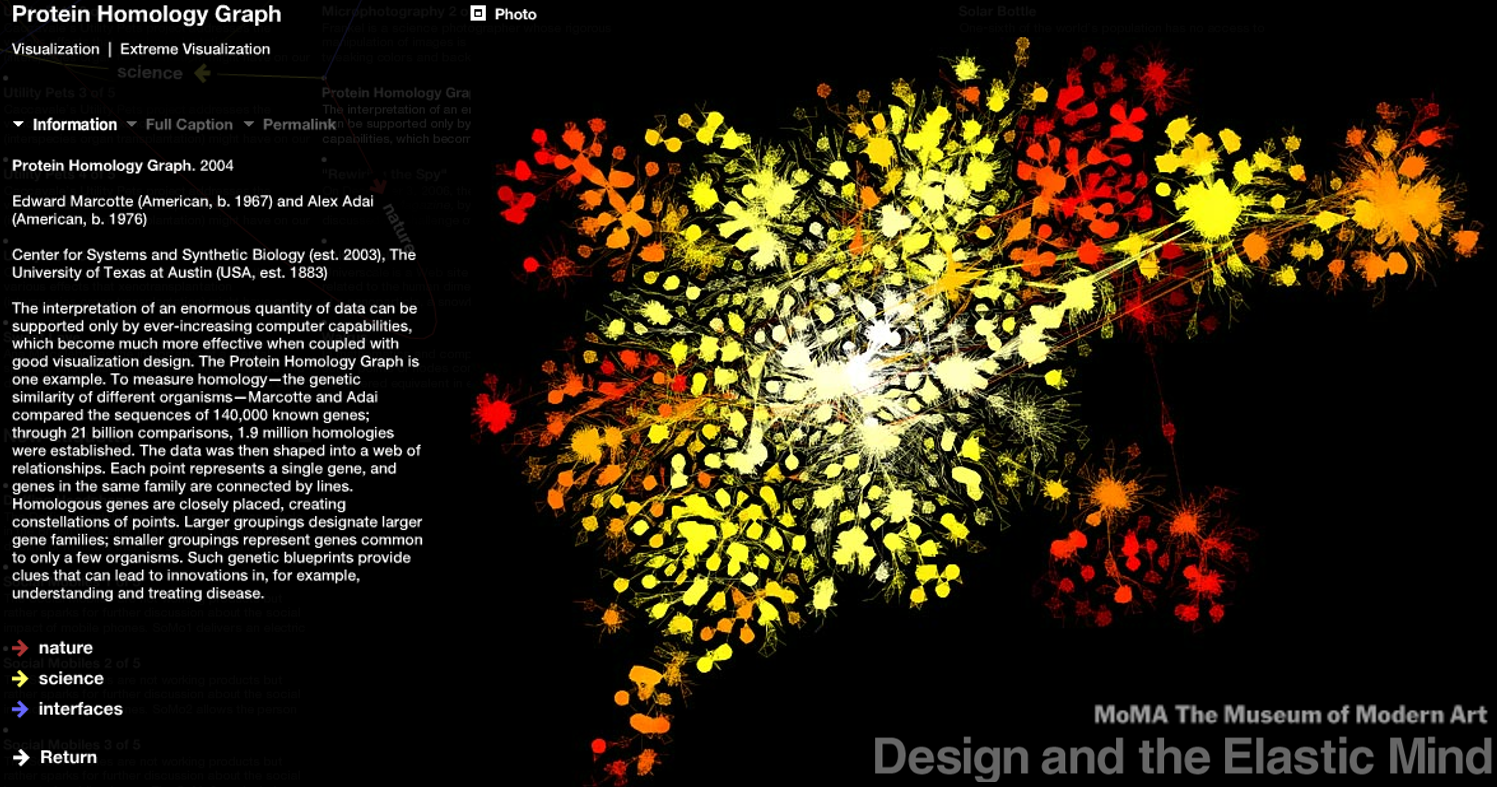
- The protein homology graph paper. Just for fun, here's a stylized version of this plot that we exhibited in the engaging Design and the Elastic Mind show at New York's Museum of Modern Art, now in their permanent collection.
- The NCBI Blast server. But Is BLAST a thing of the past? (answer: no)
- The MMSeqs2 paper
- The FoldSeek paper and a link to the FoldSeek server if you want to try it out
Jan 29, 2026 - Sequence Alignment II
- We'll be finishing up slides from last time.
- Science news of the day: Moderna, Merck's skin cancer vaccine shows sustained benefit in five-year follow-up
- Dynamic programming primer
- An example of dynamic programming using Excel, created by Michael Hoffman (a former U Texas undergraduate, now U Toronto professor, who took a prior incarnation of this class)
- A few examples of proteins with internally repetitive sequences: 1, 2, 3
Jan 26-27, 2026 - University closed for weather
Jan 22, 2026 - Sequence Alignment I
- Reminder relevant to our discussion of ChatGPT last class: CNET & other news sources used it to write articles; this Gizmodo story found that "the AI-program fabricates information and bungles facts like nobody’s business" and CNET was "forced to issue multiple, major corrections". So, if you do opt to try ChatGPT to help with Python, be sure to check (and then double-check) everything.
- CBRS is offering short (1 day) courses on computational bio topics, including intro python, stats modeling, unix/linux, bash scripting, and more
- Today's slides
Problem Set I, due 10PM Feb. 2, 2026:
- Problem Set 1
- H. influenzae genome. Haemophilus influenza was the first free living organism to have its genome sequenced. NOTE: there are some additional characters in this file from ambiguous sequence calls. When calculating your nucleotide and dinucleotide frequencies, ignore anything other than A, C, T, and G. In other words, f(A) = #A's/[#A+#C+#T+#G)] (Note from the future: edited for clarity since this was previously ambiguous.) Also, if you prefer a .fasta format file (e.g. for BioPython), just add a first line to the text file starting with a ">" character, e.g. "> Hinfluenzae genome file".
- T. aquaticus genome. Thermus aquaticus helped spawn the genomic revolution as the source of heat-stable Taq polymerase for PCR.
- 3 mystery genes (for Problem 5): MysteryGene1, MysteryGene2, MysteryGene3
- *** HEADS UP FOR THE PROBLEM SET *** If you try to use the Python string.count function to count dinucleotides, Python counts non-overlapping instances, not overlapping instances. So, AAAA is counted as 2, not 3, dinucleotides. You want overlapping dinucleotides instead, so will have to try something else, such as the python string[counter:counter+2] command, as explained in the Rosalind homework assignment on strings.
Extra reading, if you're curious:
- BLOSUM primer
- The original BLOSUM paper (hot off the presses from 1992!)
- BLOSUM miscalculations improve performance
Jan 20, 2026 - Intro to Python II
- Reminder that today will be part 2 of the "Python boot camp" for those of you with little to no previous Python coding experience. We'll be finishing the slides from last time, plus Rosalind help & programming Q/A.
- *** Rosalind assignments are due by 10 PM January 21. ***
- We'll talk a bit about ChatGPT today for co-programming. My strong recommendation for Python newbies is to not use it for writing programs when you're just getting started, but rather use it as a helper and teacher in interpreting code and suggesting commands. That way, you give yourself a chance to properly internalize the basic Python concepts, formatting, etc. Your use will increase naturally as you start to write more complex code, by which time you'll have a much better ability to gauge the correctness of its suggestions.
- Another recommendation to the Python newbies is to download Eric Matthes's great, free Python command cheat sheets that he provides to accompany his Python Crash Course book.
Jan 19, 2026 - Martin Luther King, Jr. Day; no classes (or office hours) held
Jan 15, 2026 - Intro to Python
- Remember that today and the next lecture are dedicated to the Python Boot Camp to start getting those of you with minimal coding skills up to speed on the basics. Experienced programmers can skip class!
- And a reminder about the mechanics of this class: Lectures will generally be about algorithms and concepts, while the coding help hours (or my office hours) are for you to get individual coding help and feedback. Please plan to go to coding help hours if you need that support!
- Today's slides.
- E. coli genome (formatted as a text file with no extra lines)
- E. coli genome (formatted as a fasta file, which only differs here in having a header)
- Don't forget that the Rosalind assignments are due by 10 PM January 21. Please do start if you haven't already, or you won't have time to get help if you have any issues installing Python.
- We'll use Python version 3 (any version after 3.0 should be fine; just get the latest version in Anaconda), but Rosalind and some older materials are only available in Python 2.7, so we'll generally try to be version agnostic for compatibility. For beginners, the differences are quite minimal and are summarized in a table here. There's also a great cheat sheet here for writing code compatible with both versions.
Jan 14, 2026 - Syllabus update
- Several students asked after class how travel and missed classes would be accommodated in light of the in-class attendance points. We've decided to make a single sentence change to the syllabus to indicate that, if desired, "students may use late days for missed attendance points (1 late day = 1 attendance point)." Obviously, using late days for attendance points cuts down on your ability to use them for turning in assignments late, so use them wisely.
Here is the updated course syllabus.
Jan 13, 2026 - Introduction
- Today's slides
- We'll be conducting homework using the online environment Rosalind. Go ahead and register on the site, and enroll specifically for BCH394P/364C (Spring 2026) Systems Biology/Bioinformatics using this link. Homework #1 (worth 6% of your final course grade) has already been assigned on Rosalind and is due by 10:00PM January 21.
- We'll be using the free academic Anaconda distribution of Python and Jupyter (download here). Note that there are many other options out there, such as Google colab. You're welcome to use those, but we'll restrict our teaching and TA help sessions to Jupyter/Anaconda for simplicity.
- A request for when you turn in code for Rosalind: please just cut the text code out of Jupyter and paste/upload that into Rosalind, rather than uploading the .ipynb files (which are not intended to be human readable)
Here are some online Python resources that you might find useful:
- First and foremost, and very, very useful if you're a complete Python newbie: Eric Matthes's Python Crash Course book. He made some GREAT, free Python command cheat sheets to support the book.
- Practical Python, worth checking out!
- If you have any basic experience at all in other programming languages, Google offered an extremely good, 2-day intro course to Python (albeit version 2) that is now available on Youtube.
- Khan Academy has archived their older intro videos on Python here (again, version 2)
- and, of course, you can always ask chatbots like ChatGPT to explain Python code to you, which can be extremely useful.
Syllabus & course outline
An introduction to systems biology and bioinformatics, emphasizing quantitative analysis of high-throughput biological data, and covering typical data, data analysis, and computer algorithms. Topics will include introductory probability and statistics, basics of Python programming, protein and nucleic acid sequence analysis, genome sequencing and assembly, proteomics, analysis of large-scale gene expression data, data clustering & classification, biological pattern recognition, gene and protein networks, AI/machine learning, and protein 3D structure prediction/design.
Open to graduate students and upper division undergrads (with permission) in natural sciences and engineering.
Prerequisites: Basic familiarity with molecular biology, statistics & computing, but realistically, it is expected that students will have extremely varied backgrounds. Undergraduates have additional prerequisites, as listed in the catalog.
Note that this is not a course on practical sequence analysis or using web-based tools. Although we will use these, the focus of the course will be on learning the underlying algorithms, exploratory data analyses, and their applications, esp. in high-throughput biology. By the end of the course, students will know the fundamentals of important algorithms in bioinformatics and systems biology, will be able to design and implement computational studies in biology, and will have performed an element of original computational biology research.
Most of the lectures will be from research articles and slides posted online, with some material from the...
Optional text (for sequence analysis): Biological sequence analysis, by R. Durbin, S. Eddy, A. Krogh, G. Mitchison (Cambridge University Press),
For biologists rusty on their stats, The Cartoon Guide to Statistics (Gonick/Smith) is very good. A reasonable online resource for beginners is Statistics Done Wrong. A truly excellent stats book with a free download is An Introduction to Statistical Learning, by James, Witten, Hastie, Tibshirani, and Taylor, and is accompanied by many supporting Python examples and applications.
Two other online probability & stats references: #1, #2 (which has some lovely visualizations)
No exams will be given. Grades will be based on in class attendance points (randomly assessed throughout the semester and counting 12% of the grade), online homework (counting 18% of the grade), 3 problem sets (given every 2-3 weeks and counting 15% each towards the final grade) and a course project (25% of final grade), which can be collaborative (1-3 students/project). The course project will consist of a research project on a bioinformatics topic chosen by the student (with approval by the instructor) containing an element of independent computational biology research (e.g. calculation, programming, database analysis, etc.). This will be turned in as a link to a web page. The final project is due by 10 PM, April 15, 2026. The last 3 classes will be spent presenting your projects to each other. The presentation will account for 5 (of 25) points of the project grade.
Slides will be posted before class so you can follow along with the material. It is expected that students will attend every class in person. We'll also record the lectures & post the recordings afterward on Canvas so you will have the opportunity to review lectures later. Note that the recordings will only be available on Canvas and are reserved only for students in this class for educational purposes and are protected under FERPA. The recordings should not be shared outside the class in any form. Violation of this restriction could lead to Student Misconduct proceedings. For office hours using the class zoom link, log in to the UT Canvas class page for the zoom link, or, if you are auditing, email the TA and we will send the link by return email.
Online homework will be assigned and evaluated using the free bioinformatics web resource Rosalind.
All projects and homework will be turned in electronically and time-stamped. No makeup work will be given. Instead, all students have 5 days of free “late time” (for the entire semester, NOT per project, and counting weekends/holidays). For projects turned in late, days will be deducted from the 5-day total (or what remains of it) by the number of days late (in 1-day increments, rounding up, i.e. 10 minutes late = 1 day deducted). Once the full 5 days have been used up, assignments will be penalized 10 percent per day late (rounding up), i.e., a 50-point assignment turned in 1.5 days late would be penalized 20%, or 10 points.
Homework, problem sets, and the project total to a possible 100 points. There will be no curving of grades, nor will grades be rounded up. We’ll use the plus/minus grading system, so: A= 92 and above, A-=90 to 91.99, etc. Just for clarity's sake, here are the cutoffs for the grades: 92% = A, 90% = A- < 92%, 88% = B+ < 90%, 82% = B < 88%, 80% = B- < 82%, 78% = C+ < 80%, 72% = C < 78%, 70% = C- < 72%, 68% = D+ < 70%, 62% = D < 68%, 60% = D- < 62%, F < 60%.
Students are welcome to discuss ideas and problems with each other, but all programs, Rosalind homework, problem sets, and written solutions should be performed independently (except for the final collaborative project). Students are expected to follow the UT honor code. Cheating, plagiarism, copying, & reuse of prior homework, projects, or programs from CourseHero, Github, or any other sources are all strictly forbidden and constitute breaches of academic integrity and cause for dismissal with a failing grade, possibly expulsion (UT's academic integrity policy). In particular, no materials used in this class, including, but not limited to, lecture hand-outs, videos, assessments (papers, projects, homework assignments), in-class materials, review sheets, and additional problem sets, may be shared online or with anyone outside of the class unless you have the instructor’s explicit, written permission. Any materials found online (e.g. in CourseHero) that are associated with you, or any suspected unauthorized sharing of materials, will be reported to Student Conduct and Academic Integrity in the Office of the Dean of Students. These reports can result in sanctions, including failure in the course.
The use of artificial intelligence tools (such as ChatGPT or Github co-pilot) in this class shall be permitted on a limited basis for programming assignments. You are also welcome to seek my prior-approval to use AI writing tools on any assignment. In either instance, AI writing tools should be used with caution and proper citation, as the use of AI should be properly attributed. Using AI writing tools without my permission or authorization, or failing to properly cite AI even where permitted, shall constitute a violation of UT Austin’s Institutional Rules on academic integrity.
Students with disabilities may request appropriate academic accommodations from UT Disability and Access (https://disability.utexas.edu/).
The final project website is due by 10 PM April 15, 2026
- How to make a website for the final project
- Google Site: https://sites.google.com/new
- You might also consider streamlit, which lets you generate websites on the fly direct from Python